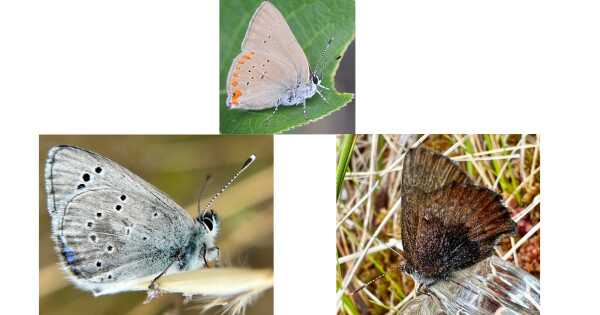
The three species below share the same family, the Gossamer-winged butterflies (Lycaenidae), which is the second largest family of butterflies in the world. But two of the species here are more closely related to each other than the third.
The Coral Hairstreak (top) is a member of the Hairstreak subfamily (Theclinae). Which of the two other species shares this subfamily?
The butterfly on the right, the Brown Elfin, is most closely related to the Coral Hairstreak with both belonging to the Theclinae Hairstreaks. The Silvery Blue shares the same family, the Gossamer-winged Butterflies, but belongs to the Blues subfamily (Polyommatinae).
According to Kawahara et al. 2023 (figure 1), these three cousin species split during the Oligocene, which took place between 34 to 23 million years ago about 20 million years after the first lepidoptera ancestry evolved. The Oligocene is better known for its cooling climate that changed the Arctic circle from a land of crocodiles to a frozen desert over millions of years. By the end of the Oligocene, most of our current animal families had evolved in their approximately modern forms.
The Brown Elfin belongs to the Callophrys group, which they share with the Green Hairstreaks like Vermont’s Juniper Hairstreak (but not the Early Hairstreak, which belongs to a different group altogether - Erora). The Coral Hairstreak belongs to the Satyrium group of Hairstreaks. These two groups split as recently as 19 million years ago during the Burdigalian (named after Bordeaux, France), a warm period where human’s first ancestors may have evolved.
Photos by
Coral Hairstreak by Sue Elwell (iNaturalist)
Brown Elfin by Kent McFarland (iNaturalist)
Silvery Blue by Alex Heymann (iNaturalist)
Ready for next weeks’ quiz? Click here!
Notice: The eButterfly Forums will be closing in 2026. The quiz will continue on the VTLEPS listserv. To join, click on the menu (box with three lines) in the right corner of the page and click Subscribe.